
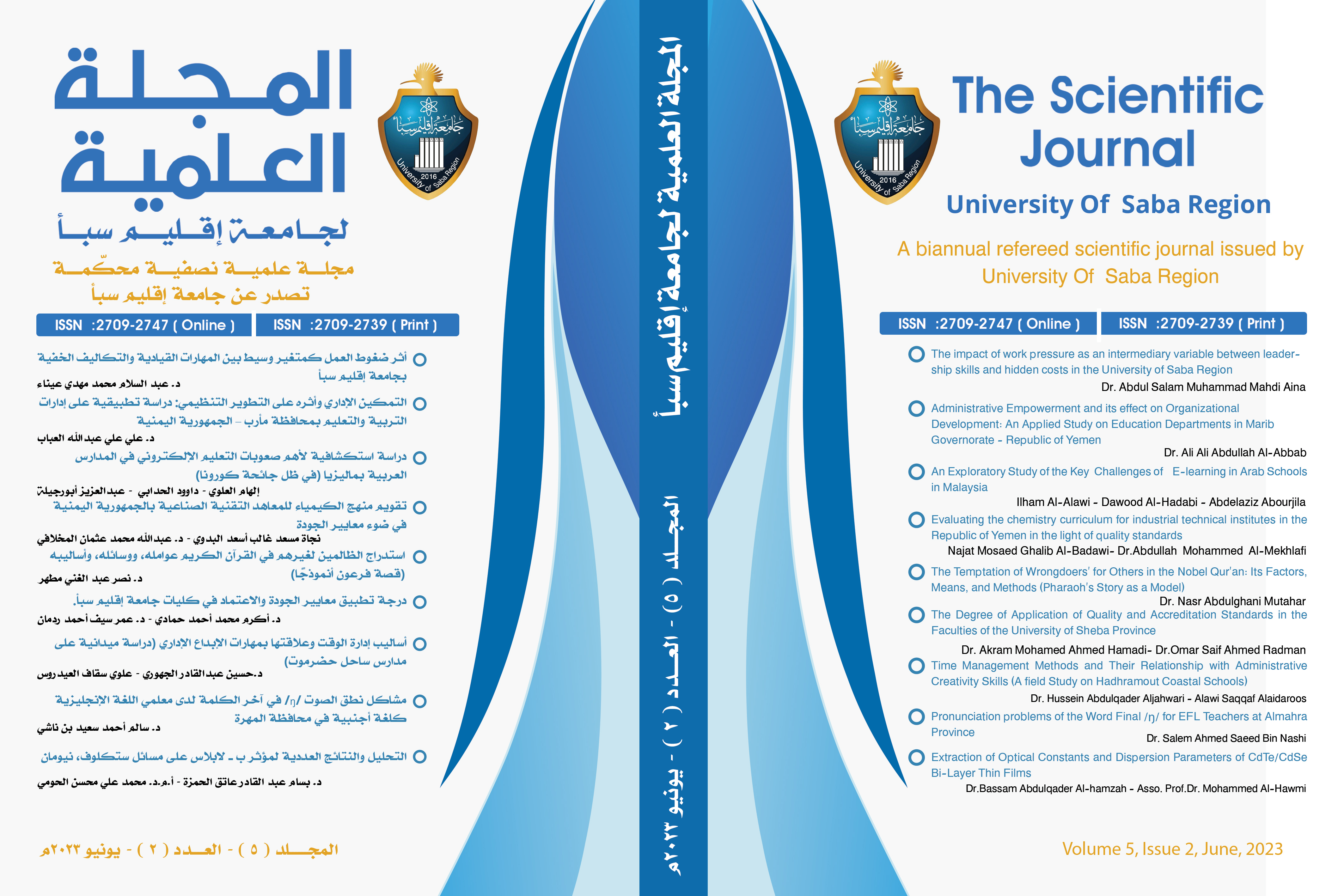
Pronunciation Problems of the sound /ŋ/ at the End of the Word among EFL Teachers in Al-Mahra Governorate
DOI:
https://doi.org/10.54582/TSJ.2.2.61Keywords:
Accuracy, Fluency, Phonetic Articulation Model, Intelligibility, Mother tongue interferenceAbstract
This study attempts to correct a common mispronunciation of the sound /ŋ/ and pronounce it as a compound sound /ŋg/ by Yemeni English teachers by applying the phonetic pronunciation model. The model was applied to a sample of 30 students from the fourth level. These students are considered trained teachers to get specific feedback about their mistakes and how to correct them especially when compared to the pronunciation of native speakers. The audio-lingual model, presented here, emphasizes the importance of teaching vocabulary pronunciation correctly. The proposed method of teaching speech can be of great benefit in treating this problem. There may not be a better way to improve poor pronunciation than to combine micro- and macro articulation skill activities to educationally and appropriately repeat problematic phonemes in a communicative context.
Downloads
Published
How to Cite
Issue
Section
License
Copyright and Licensing
This journal publishes all scientific materials under the Creative Commons Attribution 4.0 International (CC BY 4.0) , license, which grants you the following permissions:
You are free to:
- Share — copy and redistribute the material in any medium or format for any purpose, even commercially.
- Adapt — remix, transform, and build upon the material for any purpose, even commercially.
- The licensor cannot revoke these freedoms as long as you follow the license terms.
Under the following terms:
- Attribution — You must give appropriate credit , provide a link to the license, and indicate if changes were made . You may do so in any reasonable manner, but not in any way that suggests the licensor endorses you or your use.
- No additional restrictions — You may not apply legal terms or technological measures that legally restrict others from doing anything the license permits.
Notices:
You do not have to comply with the license for elements of the material in the public domain or where your use is permitted by an applicable exception or limitation .
No warranties are given. The license may not give you all of the permissions necessary for your intended use. For example, other rights such as publicity, privacy, or moral rights may limit how you use the material.