
أساليب التفكير المفضلة لدى طلبة الدراسات العليا في جامعة إقليم سبأ اليمنية وعلاقتها ببعض المتغيرات
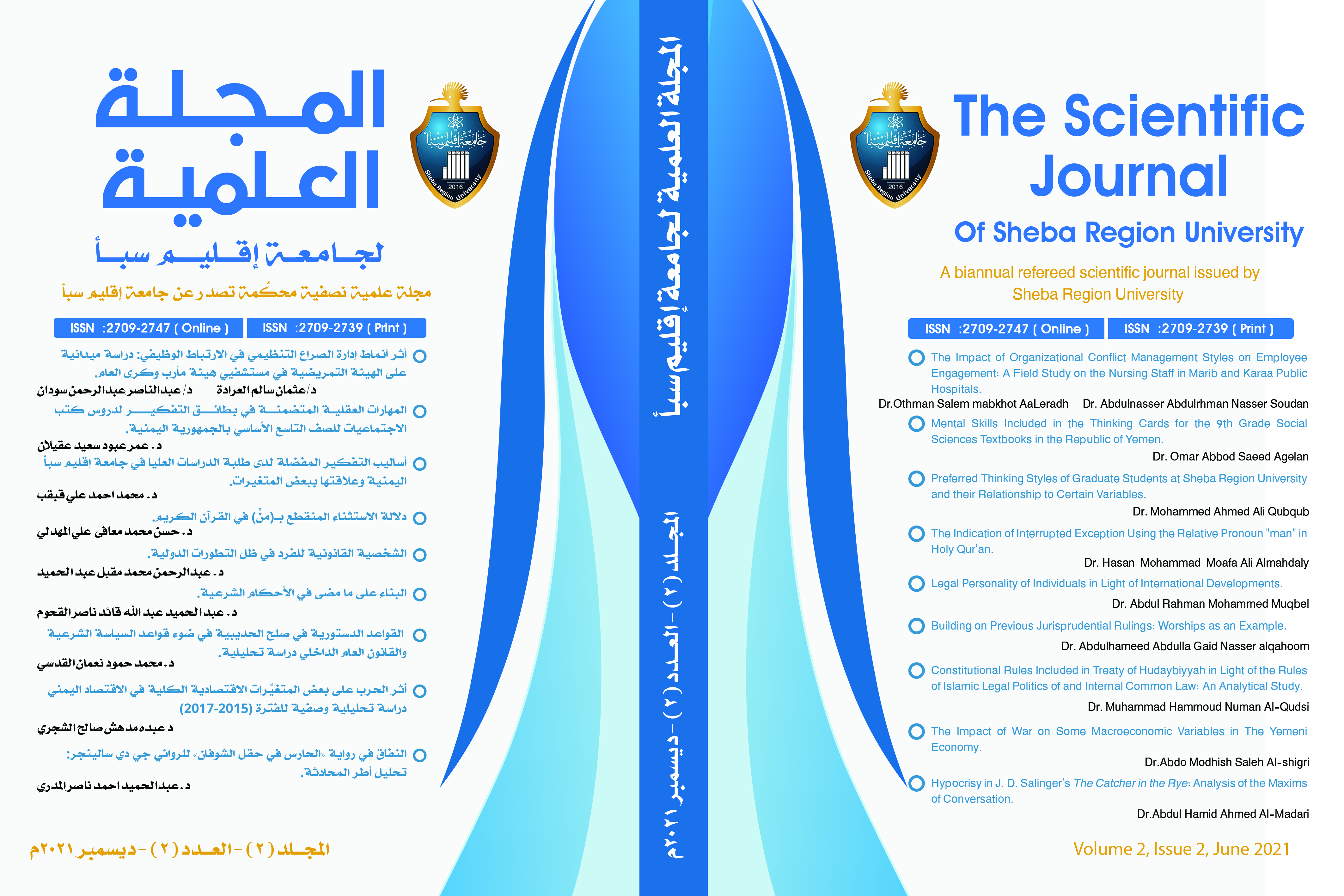
Preferred Thinking Styles of Graduate Students at Sheba Region University and their Relationship to Certain Variables
DOI:
https://doi.org/10.54582/TSJ.2.2.3Keywords:
أساليب التفكير, الدراسات العليا, جامعة إقليم سبأ, thinking styles, graduate studies, Sheba Region UniversityAbstract
هدفت الدراسة إلى الكشف عن أساليب التفكير المفضَّلة لدى طلبة الدراسات العليا في جامعة إقليم سبأ اليمنية، وتم استخدام المنهج الوصفي التحليلي القائم على المسح الميداني، ولتحقيق أهدافها أعدَّ الباحث مقياسا وفق نظرية هاريسون وبراميسون (1982م) من (15) موقفًا، وكل موقف منها اشتمل على خمس فقرات؛ لتقيس كل فقرة أحد أساليب التفكير الخمسة (المثالي، والواقعي، والعملي، والتحليلي، والتركيبي) التي يتكون منها المقياس الكلي، وتكونت العينة من(80) طالبًا وطالبة من طلبة الدراسات العليا في كليتي التربية والآداب والعلوم، وعلوم الحاسوب وتقنية المعلومات في العام 2019/ 2020م ، وتوصَّلت الدراسة إلى عدة نتائج؛ من أهمها أنَّ ترتيب أسلوب التفكير الواقعي حصل على المرتبة الأولى في تقديرات الطلبة عن مدى تفضيلاتهم لأساليب التفكير، يليه أسلوب التفكير(التحليلي، فالعملي، ثم المثالي، وأخيرًا أسلوب التفكير التركيبي، كما كشفت النتائج عن عدم وجود فروق دالة احصائيًا تعزى لمتغيرات(النوع، والكلية، والقسم الأكاديمي) بشكل عام.
وتضمنت الدراسة عددًا من الاستنتاجات والتوصيات والمقترحات.
Abstrac
The study aimed at revealing the preferred thinking styles of graduate students at Sheba Region University. The descriptive analytic approach based on field surveys was followed in the study. To achieve the study objectives, the researcher prepared a scale of (15) domains according to the theory of Harrison and Bramson where each domain included (5) items. Each one of these items measured one of the five thinking styles (idealist, realist, pragmatist, analyst, and synthesist). The validity and reliability of the scale were verified by the known scientifically psychometric methods. The sample of the study consisted of (80) graduate students in the Faculty of Education, Arts and Sciences and the Faculty of Computer Science and Information Technology in the academic year of 2019/2020. The study concluded that the realistic thinking style ranks first in the students’ estimates of their preferences for thinking styles, followed by the analytical, practical, idealistic, and synthetic thinking styles respectively. The results also revealed that there are no statistically significant differences attributed to the variables of gender, college, and academic department.
Downloads
Published
How to Cite
Issue
Section
License
Copyright and Licensing
This journal publishes all scientific materials under the Creative Commons Attribution 4.0 International (CC BY 4.0) , license, which grants you the following permissions:
You are free to:
- Share — copy and redistribute the material in any medium or format for any purpose, even commercially.
- Adapt — remix, transform, and build upon the material for any purpose, even commercially.
- The licensor cannot revoke these freedoms as long as you follow the license terms.
Under the following terms:
- Attribution — You must give appropriate credit , provide a link to the license, and indicate if changes were made . You may do so in any reasonable manner, but not in any way that suggests the licensor endorses you or your use.
- No additional restrictions — You may not apply legal terms or technological measures that legally restrict others from doing anything the license permits.
Notices:
You do not have to comply with the license for elements of the material in the public domain or where your use is permitted by an applicable exception or limitation .
No warranties are given. The license may not give you all of the permissions necessary for your intended use. For example, other rights such as publicity, privacy, or moral rights may limit how you use the material.