
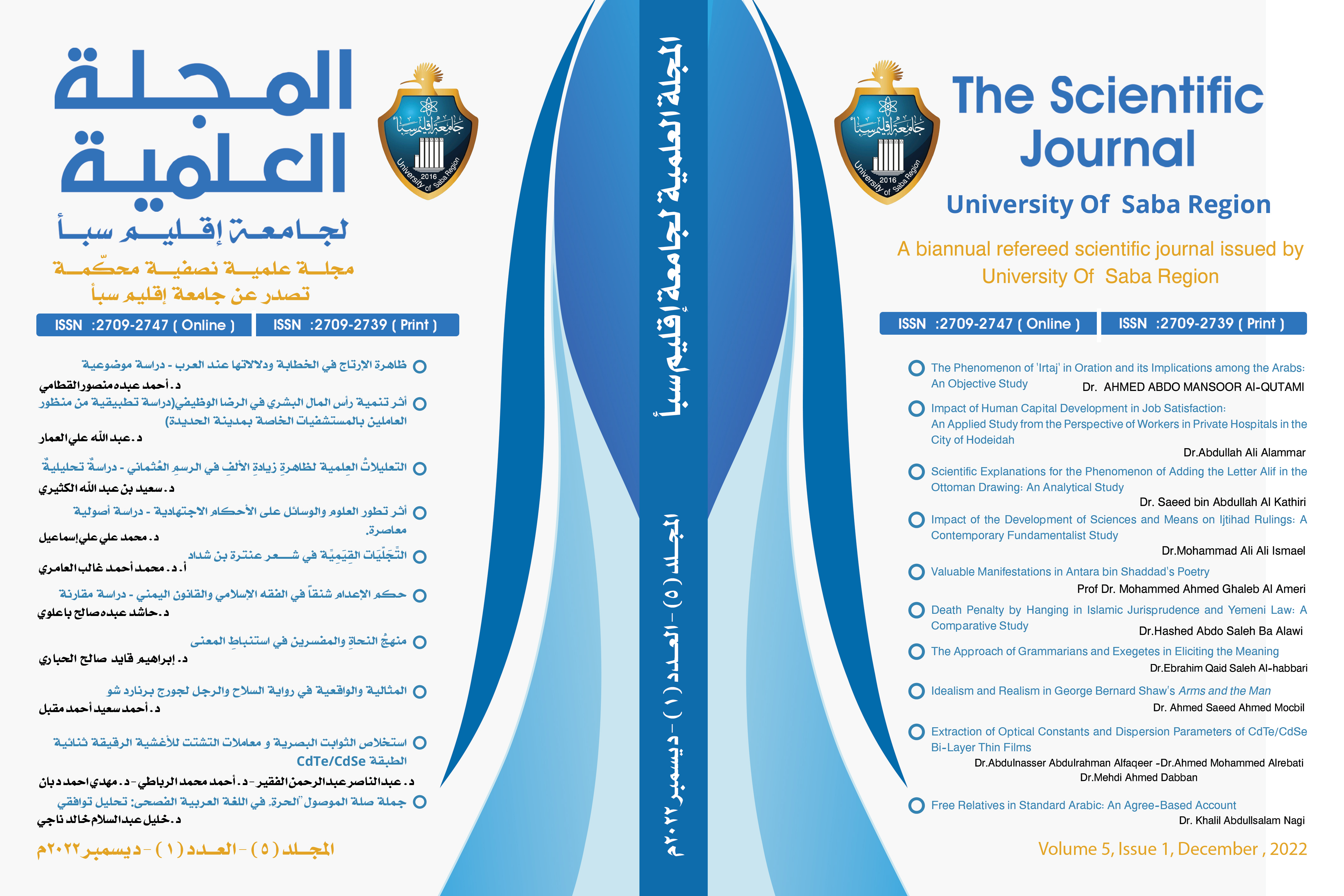
Free Relatives in Standard Arabic: An Agree-Based Account
DOI:
https://doi.org/10.54582/TSJ.2.2.53Keywords:
Arabic, free relatives, agreement, word order, case, relative pronounsAbstract
This work examines free relative constructions in Standard Arabic (henceforth SA or Arabic) and aims to provide an agree-based analysis for those constructions. The study introduces the free relatives and how they differ from headed relative constructions. It also discusses the nominal nature of SA free relatives. In addition, the study discusses some syntactic properties of the construction under study such as word order and agreement. It also examines the nature of the relative elements man, ma, and allaði and its set. The study introduces a syntactic analysis of SA free relatives that is based on Groos and van Riemsdijk (1981), Caponigro (2000), and Himmelreich (2017) which proposes the movement of the relative pronoun from base generation position to the Spec of the CP headed by an empty D. The analysis accounts for the case matching in Arabic free relatives.
Downloads
Published
How to Cite
Issue
Section
License
Copyright and Licensing
This journal publishes all scientific materials under the Creative Commons Attribution 4.0 International (CC BY 4.0) , license, which grants you the following permissions:
You are free to:
- Share — copy and redistribute the material in any medium or format for any purpose, even commercially.
- Adapt — remix, transform, and build upon the material for any purpose, even commercially.
- The licensor cannot revoke these freedoms as long as you follow the license terms.
Under the following terms:
- Attribution — You must give appropriate credit , provide a link to the license, and indicate if changes were made . You may do so in any reasonable manner, but not in any way that suggests the licensor endorses you or your use.
- No additional restrictions — You may not apply legal terms or technological measures that legally restrict others from doing anything the license permits.
Notices:
You do not have to comply with the license for elements of the material in the public domain or where your use is permitted by an applicable exception or limitation .
No warranties are given. The license may not give you all of the permissions necessary for your intended use. For example, other rights such as publicity, privacy, or moral rights may limit how you use the material.