
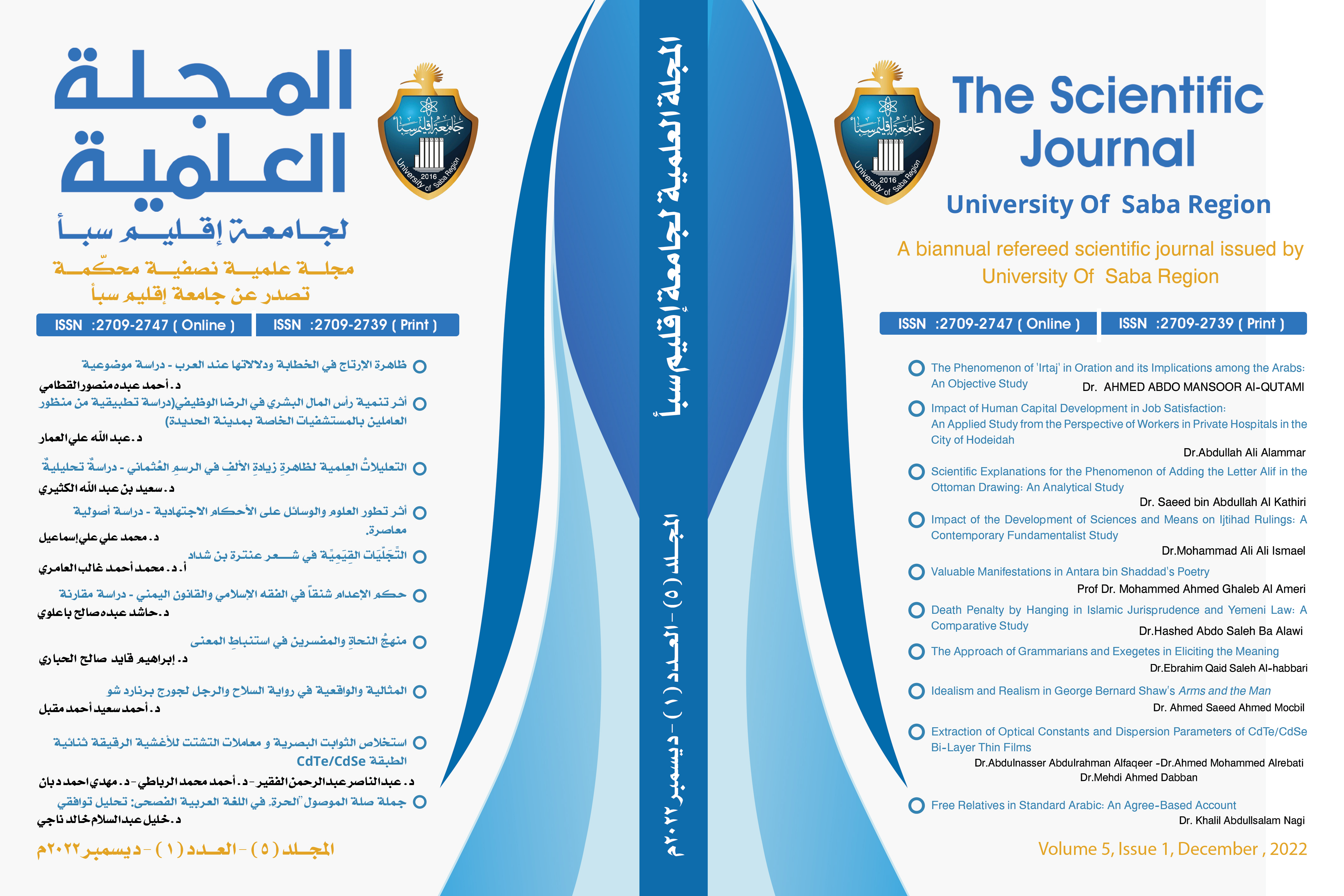
Idealism and Realism in George Bernard Shaw’s Arms and the Man
DOI:
https://doi.org/10.54582/TSJ.2.2.51Keywords:
realism, idealism, Conventional behavior and satireAbstract
Generally, George Bernard Shaw defines literature as the mirror of the society. He presents his looking-glass by portraying the good and bad ideas of his society. He is the playwright who attached the romanticism through the naturalism movement that started at the middle of the 19th century to replace romanticism. This research aims to reveal the private follies of the characters in George Bernard Shaw’s Arms and the Man, in terms of their idealism and realism in war and love. This play is a satire on the foolishness of glorifying war, as well as on idealistic notions of love. Through it, Shaw tries to reflect the reality of his period of time and society. He harshly criticizes the notion of war because of its terrible consequences such as bloodshed, destruction and poverty. About love, he emphasizes that it is important to follow ones heart in marriage not social status or appearances. The methodology of the study is analytical. In conclusion, the results show that Shaw’s aims to reform society’s conventional behavior to rescue it from fake changing of characters idealism notions of war and love at the end of the play achieved idealism to become more realism, especially that relate to marriage.
Downloads
Published
How to Cite
Issue
Section
License
Copyright and Licensing
This journal publishes all scientific materials under the Creative Commons Attribution 4.0 International (CC BY 4.0) , license, which grants you the following permissions:
You are free to:
- Share — copy and redistribute the material in any medium or format for any purpose, even commercially.
- Adapt — remix, transform, and build upon the material for any purpose, even commercially.
- The licensor cannot revoke these freedoms as long as you follow the license terms.
Under the following terms:
- Attribution — You must give appropriate credit , provide a link to the license, and indicate if changes were made . You may do so in any reasonable manner, but not in any way that suggests the licensor endorses you or your use.
- No additional restrictions — You may not apply legal terms or technological measures that legally restrict others from doing anything the license permits.
Notices:
You do not have to comply with the license for elements of the material in the public domain or where your use is permitted by an applicable exception or limitation .
No warranties are given. The license may not give you all of the permissions necessary for your intended use. For example, other rights such as publicity, privacy, or moral rights may limit how you use the material.