
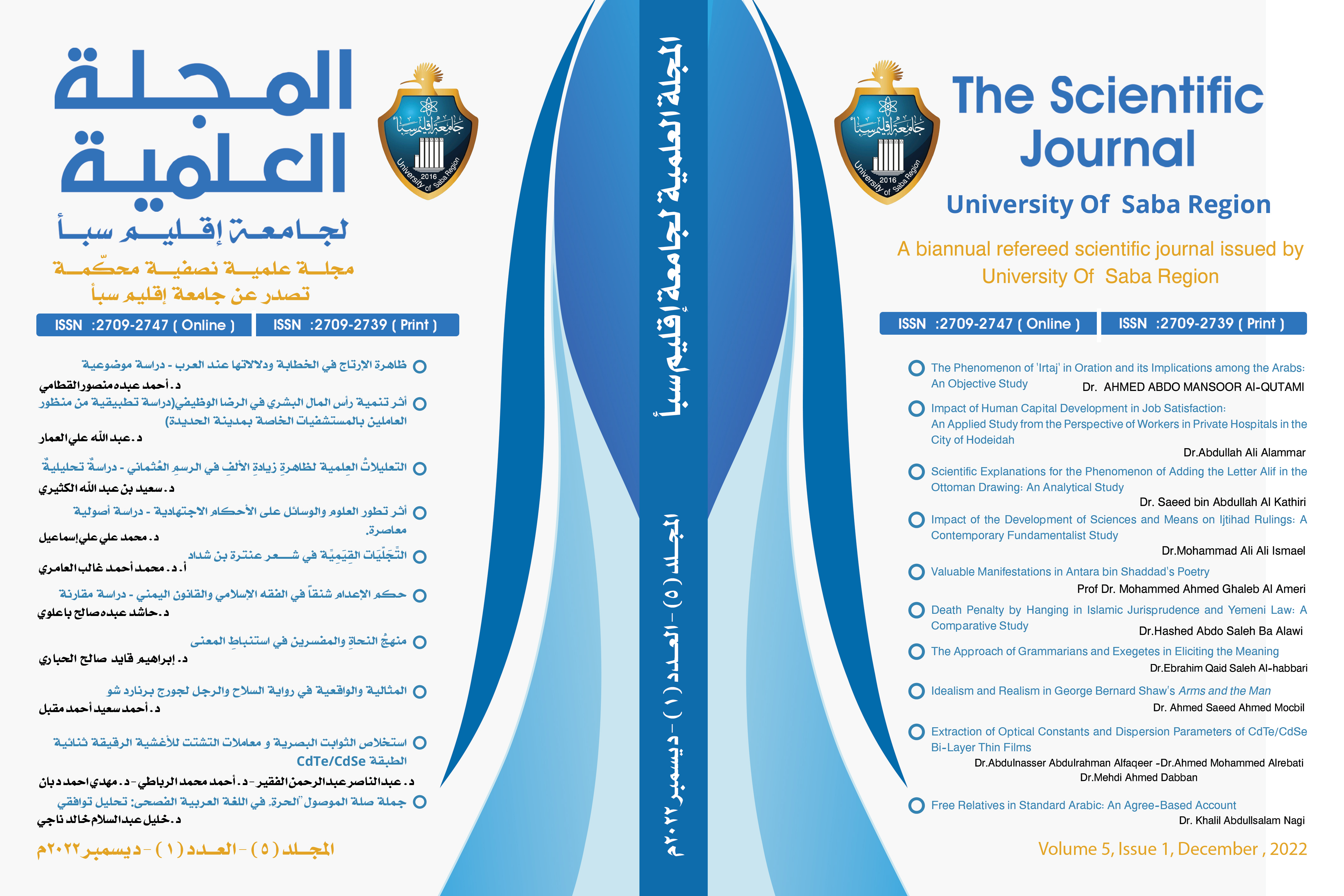
Impact of the Development of Sciences and Means on Ijtihad Rulings: A Contemporary Fundamentalist Study
DOI:
https://doi.org/10.54582/TSJ.2.2.47Keywords:
development, sciences, means, rulingsAbstract
The research aims to show the impact of the development of sciences and means on the ijtihad rulings that accept change, and the reasons for change, with reference to the most famous contemporary applications in this concern. The researcher has arrived at certain findings: the rulings that accept change are ijtihad rulings based on a jurisprudential principle, analogy or care of interest, and so on; whereas the fixed basic rulings do not accept change because of its flexibility and its validity for every time and place and its principles such as facilitation and removal of awkwardness. And the most important factors for changing rulings are: change of time and place, convention and custom, change of morals, care of interest and corruption, and the development of sciences. Among the most prominent contemporary applications in which the jurisprudential ruling has changed due to the development of sciences and means are the issue of entering the Hijri month, the issue of giving a final sentence about the harm of smoking, knowing the maximum duration of pregnancy, removing the fetus after it has been proven that its survival threatens the life of the mother, and the issue of splitting the abdomen of a dead woman to remove the living fetus according to Al-Saadi who issued a fatwa, opposite to Hanbali doctrine, that it is permissible to remove the living fetus from the dead mother because surgery has developed, and such an act has become closer to the interest than to the corrupt. The researcher also recommended comparatively studying the issues of ijtihad rulings in which the ruling was affected by the development of contemporary means, and holding seminars and conferences that bring together Sharia scholars and scholars of other disciplines related to modern sciences.
Downloads
Published
How to Cite
Issue
Section
License
Copyright and Licensing
This journal publishes all scientific materials under the Creative Commons Attribution 4.0 International (CC BY 4.0) , license, which grants you the following permissions:
You are free to:
- Share — copy and redistribute the material in any medium or format for any purpose, even commercially.
- Adapt — remix, transform, and build upon the material for any purpose, even commercially.
- The licensor cannot revoke these freedoms as long as you follow the license terms.
Under the following terms:
- Attribution — You must give appropriate credit , provide a link to the license, and indicate if changes were made . You may do so in any reasonable manner, but not in any way that suggests the licensor endorses you or your use.
- No additional restrictions — You may not apply legal terms or technological measures that legally restrict others from doing anything the license permits.
Notices:
You do not have to comply with the license for elements of the material in the public domain or where your use is permitted by an applicable exception or limitation .
No warranties are given. The license may not give you all of the permissions necessary for your intended use. For example, other rights such as publicity, privacy, or moral rights may limit how you use the material.