
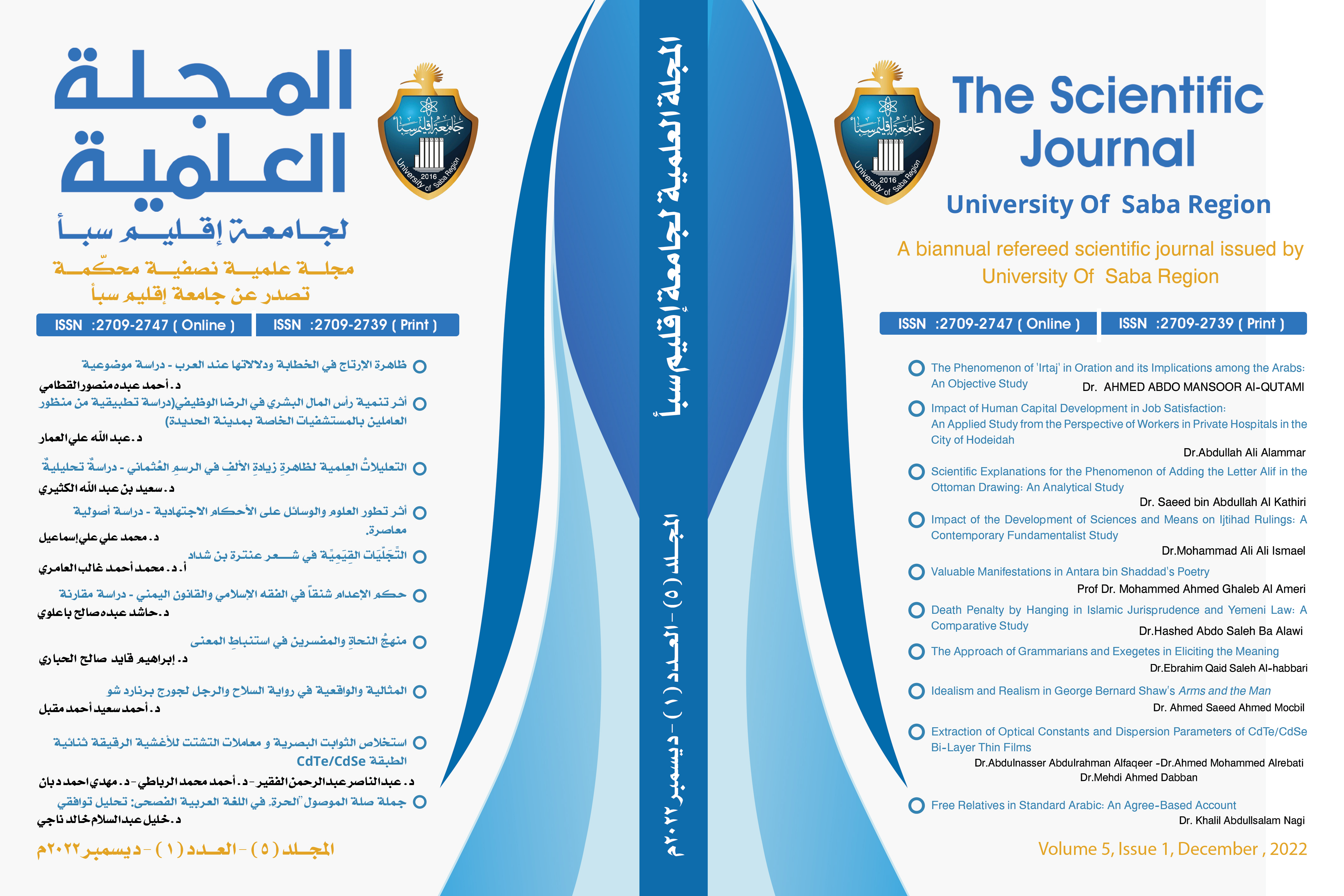
The Phenomenon of ‹Irtaj› in Oration and its Implications among the Arabs: An Objective Study
DOI:
https://doi.org/10.54582/TSJ.2.2.44Keywords:
Irtaj, dyslogia, stammering, oration, semantics, interpretationAbstract
Irtaj, stopping or inability to continue speaking, is one of the phenomena of ancient Arabic literature. It is associated with oration more than its association with other literary types. It refers to the preacher’s inability to continue his sermon (oration) for some reasons. It may occur because of the astonishment of the large number of listening audience, the seriousness of the situation expressed by the preacher, or because of other reasons. Old books were concerned with the stories of those who experienced these situations, from the famous eloquent and the lords of the tongue, in order to monitor their treatment of these lingering cases, and how they were divided into categories: some of them apologized, some of them misbehaved, and others created alternative speeches. The study has been concerned with monitoring this phenomenon, defining it, listing its evidence, its connotations, and the significance of the authors’ interest in presenting its texts. All that was made within the framework of the method of interpretation of texts. Through this investigation, it has become clear that there are many implications and dimensions of this phenomenon. The research approached a number of these dimensions and implications. It is concluded with recommendations about this phenomenon and other similar phenomena.
Downloads
Published
How to Cite
Issue
Section
License
Copyright and Licensing
This journal publishes all scientific materials under the Creative Commons Attribution 4.0 International (CC BY 4.0) , license, which grants you the following permissions:
You are free to:
- Share — copy and redistribute the material in any medium or format for any purpose, even commercially.
- Adapt — remix, transform, and build upon the material for any purpose, even commercially.
- The licensor cannot revoke these freedoms as long as you follow the license terms.
Under the following terms:
- Attribution — You must give appropriate credit , provide a link to the license, and indicate if changes were made . You may do so in any reasonable manner, but not in any way that suggests the licensor endorses you or your use.
- No additional restrictions — You may not apply legal terms or technological measures that legally restrict others from doing anything the license permits.
Notices:
You do not have to comply with the license for elements of the material in the public domain or where your use is permitted by an applicable exception or limitation .
No warranties are given. The license may not give you all of the permissions necessary for your intended use. For example, other rights such as publicity, privacy, or moral rights may limit how you use the material.